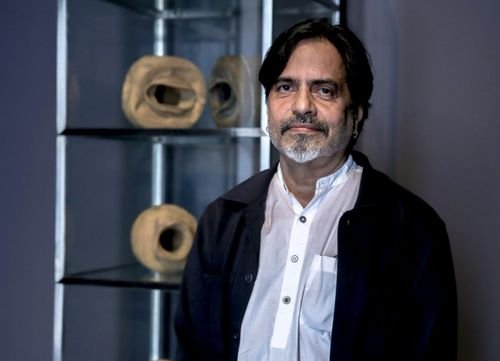
Sudharshan Shetty is a prominent contemporary artist known for his immersive installations that blend the everyday with the extraordinary. Shetty initially trained as a painter before transitioning to sculpture and installation work, creating enigmatic works that invite views to examine the boundaries between the animate and inanimate, spirituality and consumerism. His recent installation at the Impasse Beaubourg gallery in Paris features hundreds of miniature Taj Mahal replicas, a poignant commentary on modern mercantilism and Indian society, and the fleeting nature of beauty. This work combines video and sculpture to meditate on the mausoleum, the themes of absence, memory and loss inherent to his practice. Shetty’s art is culturally and contextually rich, employing materials and forms which evoke personal and collective histories. He has exhibited widely – such prestigious venues as the Centre Pompidou – and was the Curator of the 2016 edition of the Kochi-Muziris Biennale. His work engages deeply with the human experience and is thus universally resonant and memorable.
Sudarshan Shetty’s ‘One Life Many’ unfolds as an introspection on change, identity, and the fluid interplay between reality and illusion. It is not a narrative in the conventional sense but a constellation of images and objects, each connected like cross-currents in a stream, pulling the viewer into a space where boundaries collapse and meanings are constantly shifting.
At the heart of the exhibition is a central video work—a retelling of the tale from the Bhagavata Purana, where Narada, the celestial sage, momentarily loses himself in the illusion of life created by Vishnu’s divine play, emphasising the fluidity of roles and the power of illusion. This myth becomes a vessel for exploring the multiplicity of selfhood, the illusions that construct our sense of reality, and the seamless transitions between identities. Filmed during the stillness of the pandemic, the video draws on this quiet disruption, juxtaposing the ancient and the contemporary, dissolving distinctions between past and present, permanence and impermanence.
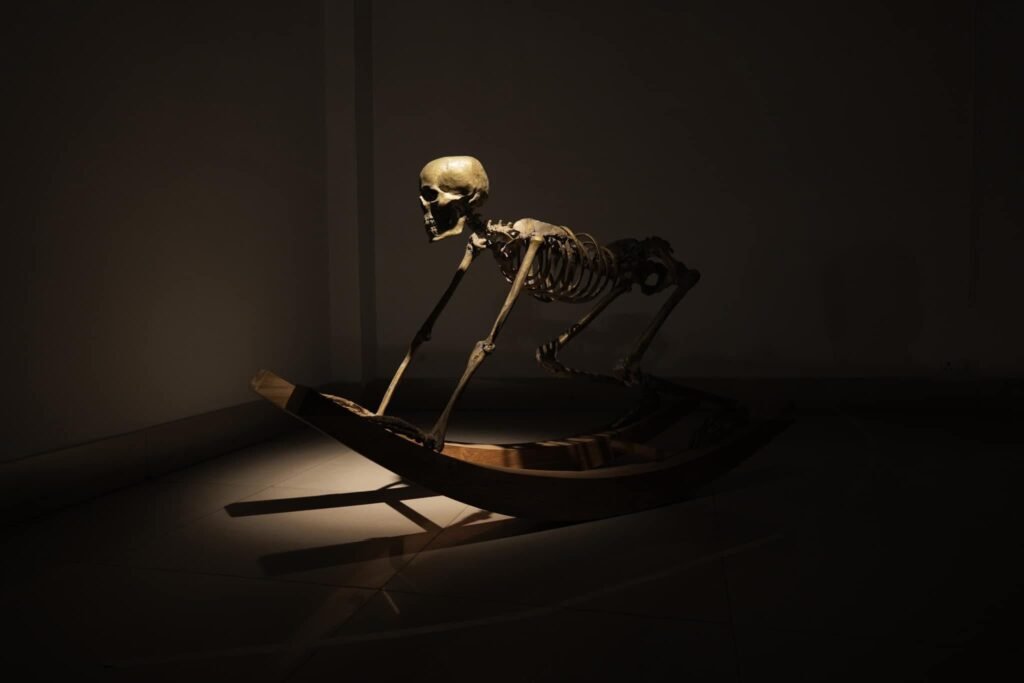
Surrounding the video are three sculptural works—objects that appear familiar but carry the weight of transformation with them. Shetty takes mundane, often obsolete forms and renders them in unexpected materials, creating objects that simultaneously recall and resist their original utility. These are not mere artefacts; they are evidence of change, embodying the tension between what was and what is becoming. Like currents meeting in turbulent waters, they suggest a dialogue between the physical and the metaphysical, between the human and the object.
The exhibition resists linearity, much like the myth it reimagines. Instead, it invites us to consider the intersections—where identities shift, objects and narratives converge, and where the fixed dissolves into the fluid. Shetty’s practice operates within this space of cross-currents, offering not answers but provocations.
What does it mean for an object to carry memory? For a story to transform with each retelling? For a self to hold multiplicities? In One Life Many, these questions remain suspended, their answers as transient as the ripples in a stream. Shetty does not resolve these tensions but leaves them open, urging us to inhabit the space where they intersect—where transformation is not a moment but a continuous process.