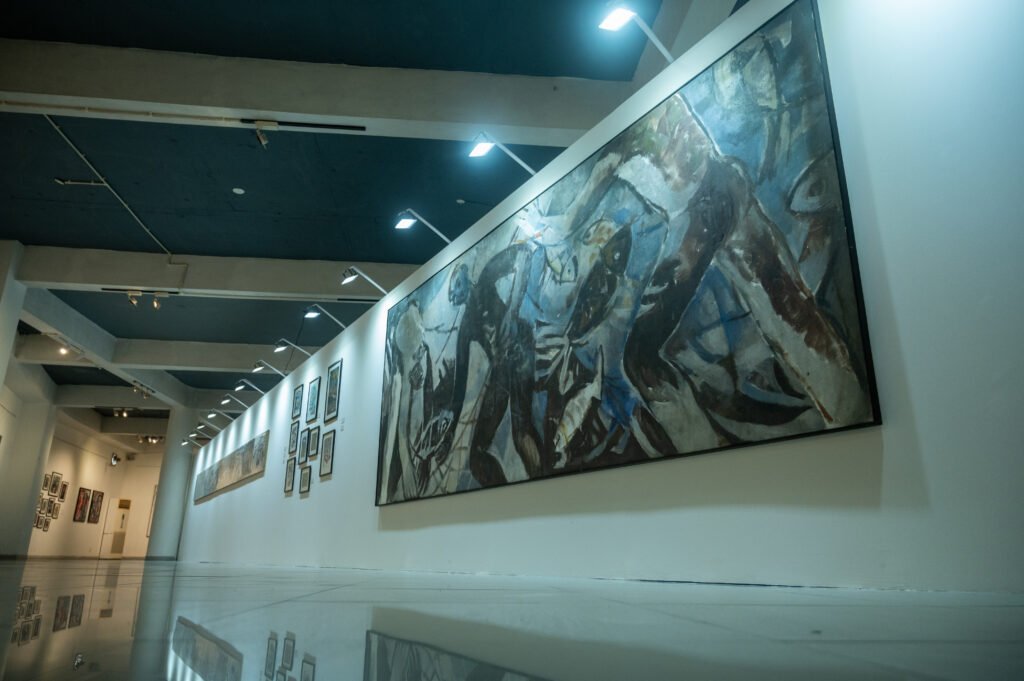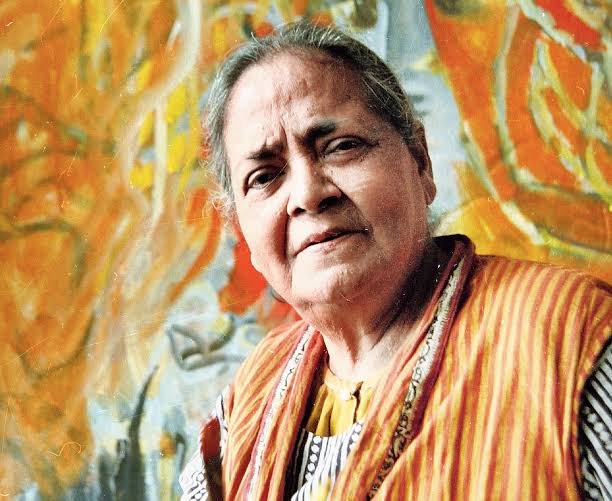
Shanu Lahiri was a painter, art educator and activist. She was a first-generation modernist, having emerged post-Independence, and was often dubbed the ‘First Lady’ of public art in Kolkata, owing to her prominence in the practice. Lahiri’s time in Paris and the vocabularies of European modernism were constant points of reference for her own innovations with form, colour and content, culminating in a trademark style – contorted human figurations, assertive lines and brushstrokes, bold colours, and a predilection for vast sizes and scale. While she communicated compelling, unfolding narratives and important social issues, it was the human figure that remained her forte. Lahiri was essential to the mobilisation of the first group of women artists in the 80s – the collective – ‘The Group’ – exhibited annually at the Academy of Fine Arts, even travelled internationally, and, importantly, advocated for the equal participation of women practitioners in the art-world. She was for a time the Dean of the Faculty of Visual Arts at Rabindra Bharati University. Lahiri’s fascinating legacy is illuminated by Smritir Collage, and continues to fuel contemporary art and dialogue.
Shanu Lahiri’s life and work embody a quiet rebellion against the conventions of art and the societal structures that define its audience. For her, the canvas extended into the streets, onto walls, and into the lives of people. Lahiri embraced radical inclusivity; engaging communities often left out of the aesthetic discourse of the city. Born in an era when women artists were marginalised, Lahiri shaped her career with a vision that was both fiercely individual and deeply collaborative. She immersed herself in art history but expressed it without elitism. This exhibition is not a retrospective but a conversation – between Lahiri and the city she loved, between the formalism and experimentation as a prominent member of ‘The Group’ she co-founded, and the streets of Kolkata she transformed or the women she painted. Viewing her art means engaging in reimagination, understanding that every surface holds the potential for beauty and that every space can become a canvas for collective transformation.