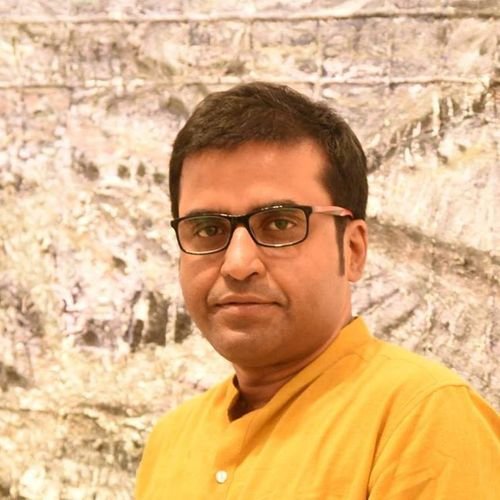
Samindranath Majumdar is an artist, educator, and art-activist based in India. He holds a postgraduate degree in History of Art from Rabindra Bharati University. Since 1988, Majumdar has actively participated in numerous group exhibitions worldwide, while hosting eight solo exhibitions. His artistic contributions have earned him three national awards and several state honours, as well as the Ebrahim Alkazi Endowment Scholarship for research. In addition to his practice, he has curated an international exhibition at the ICCR in Kolkata, in collaboration with Emergent Art Space, San Francisco. Majumdar has participated in art camps, including the ASEAN workshop in 2016, and he mentored the ‘Oceans of Connectivity’ workshop in 2022, fostering collaboration between ASEAN and Indian artists.
A published poet and author, he contributed to Kothay Kothay Jai (1993) and The Great Journey of Shapes: Collages of Nandalal Bose. He is also an honorary member of the advisory board for Emergent Art Space. Currently, he teaches Fine Arts (Painting) at The Indian College of Arts & Draftsmanship in Kolkata.
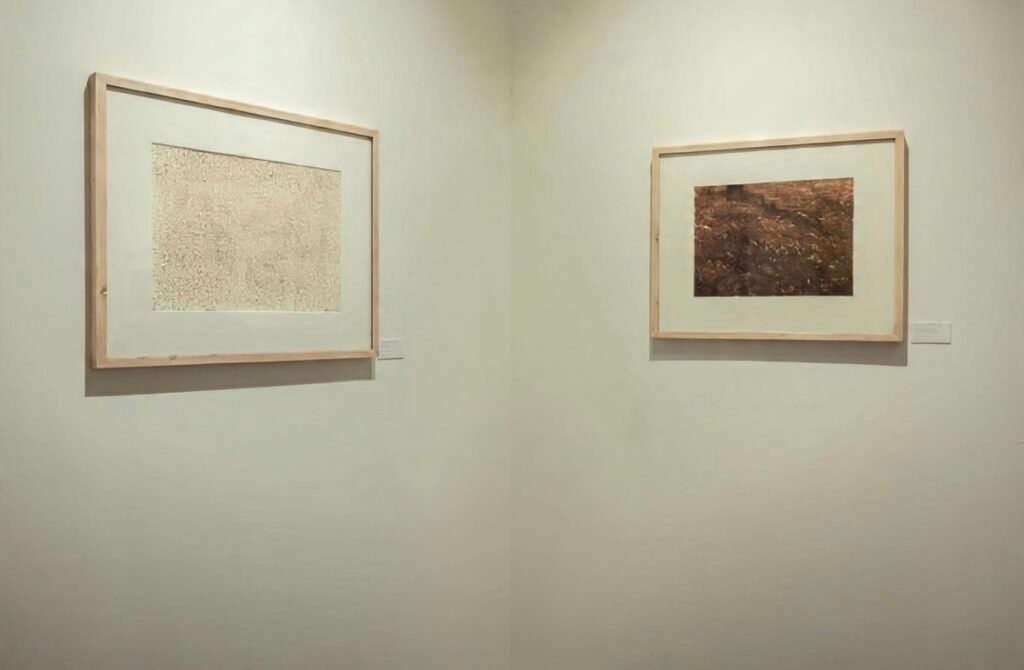
In these works by Samindranath Majumdar, landscapes serve as spaces where the past and future intertwine. Each image—a fractured boat, an ancient tortoise, a house long abandoned—speaks not only of what once was but hints at a future sculpted by the forces of climate change and human apathy. Produced with pyrography, these scenes suggest that the landscapes Majumdar creates are not mere relics of the past but premonitions of what is yet to come.
Experimentation-prone Majumdar’s use of pyrography is more than just a technique; it is a means of revelation. By burning lines into thick, acid-free paper, he transforms fragile surfaces into landscapes marked by both time and elemental force (…). Each stroke darkened by fire exposes layers beneath, conjuring textures of weathered stone, wood and eroded structures. This method imbues these forms with life—akin to geological processes of slow accumulation and erosion—pressed further by the intensifying changes in climate and environment. With their charred marks and layered depth, Majumdar’s landscapes evoke not abandonment but a process of becoming (…).
In Majumdar’s hands, the ancient and contemporary collapse into one another, creating a new reality where survival is uncertain. His works, with their textured surfaces and scorched lines, suggest a future born from the ruins of the present (…). The wrecked ship, abandoned houses, tranquil water bodies and scattered traces of human presence evoke a world where human neglect and the cycles of nature leave their indelible marks.
Majumdar’s landscapes are not about loss but about endurance—about how even the most worn forms carry the resilience to persist. Each charred mark adds to an ongoing narrative shaped by the consequences of human action. Through these works, Majumdar reveals that history is not confined to the past, but embedded in the present, waiting to be uncovered.
In these works, there is a stillness, but within that calm resides the relentless passage of time. Majumdar’s landscapes, etched with fossils and burned into existence, point not to a lost past but to what remains after change, suggesting that every line and shadow speaks of transformation. These images invite the viewer into an archaeology of survival, offering a vision of landscapes alive with memory, awaiting the future they will reveal.