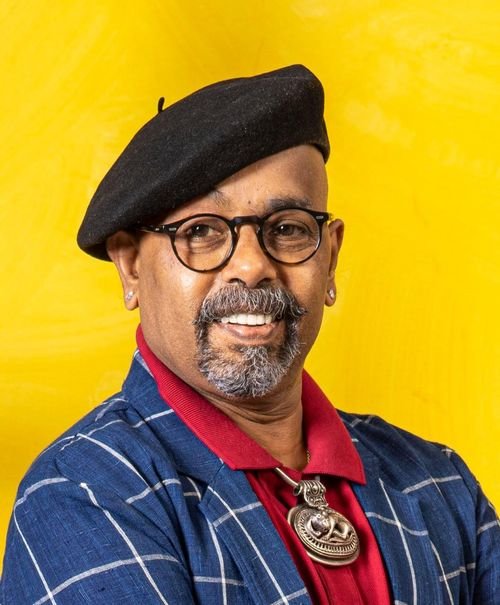
Renowned and acclaimed artist Paresh Maity was born in the historical town of Tamluk, close to Kolkata, in 1965. After his education at Hamilton High School, he received his Bachelor’s Degree in Fine Arts from one of the oldest and most prestigious art colleges in India, Government College of Arts and Crafts, Kolkata followed by a Master’s Degree in Fine Arts from the College of Art, New Delhi, being the top of his class in both. Spanning nearly four decades of his artistic oeuvre, he has created and explored various mediums in art including watercolour, oil and acrylic paintings, mixed media, sculptures and photography. During the last 35 years, he has held 88 solo exhibitions and his work including a diverse ensemble of landscapes, abstracts, portraits and figures has been widely exhibited in galleries, museums and art fairs in India and across the globe. His art has been collected by numerous private collectors across the world and is also present in public collections such as the Rashtrapati Bhawan (President’s House, India); the British Museum in London; the Rubin Museum of Art, New York; National Gallery of Modern Art, New Delhi; the Oberoi Group of Hotels; Taj Group of Hotels; Leela Palace Hotel, New Delhi; Ritz Carlton Hotel, Bengaluru; ITC Limited Welcome Group Hotels, Tata Iron & Steel Co. Ltd and Hindustan Lever among many others. In 2010, he completed an approximately 850-foot mural, one of the longest paintings in the world for the International Terminal at the Indira Gandhi International Airport, New Delhi. He has been felicitated by various national and international institutions including the Royal Watercolour Society in London, the All India Fine Arts and Crafts Society and British Council. He is a recipient of one of the highest civilian awards, the Padma Shri, from the Government of India. Most recently in 2024, he was conferred with D.Litt from Sir Padampat Singhania University, Udaipur.
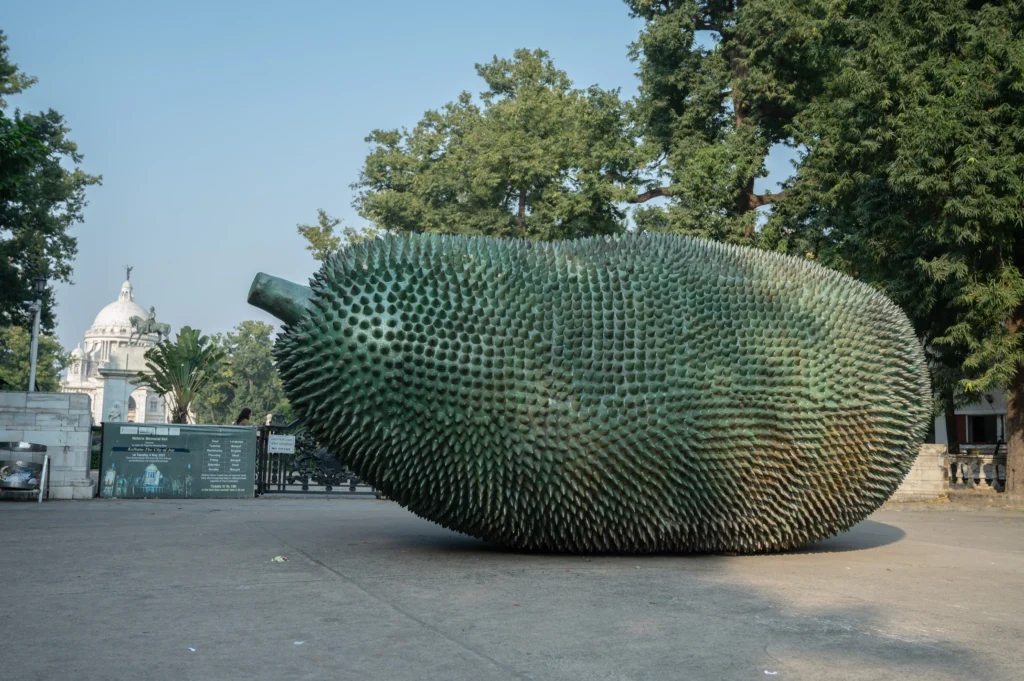
In Urbanscape (2019), Paresh Maity takes the urban sprawl and condenses it into the form of a jackfruit, or kanthal— an object sharp and unforgiving but deeply resonant with memories of home. Cast in bronze, the sculpture’s spiked exterior mirrors the cramped, jostling structures of metropolitan life, where human habitation is reduced to tight proximity, each dwelling pressed against the next in relentless succession. Each spike, then, becomes a marker of isolation within the collective—a meditation on the confinement and tension of modern urbanity.
Here, Maity plays with the irony embedded in the Bengali phrase ‘Gacche kathal, Gofe tel’— an expectation of comfort prematurely savoured, as if city life promises more than it delivers. The spikes hint at anticipation, only to reveal the prickly reality of urban existence. Maity’s sculpture critiques this suspended promise of the metropolis, transforming the fruit into a symbol of both allure and disillusionment.
Yet, Urbanscape is more than a sculptural critique. It is Maity’s personal narrative, too, for the kanthal holds the taste of home, a memory that cuts through the clamour of city life and recalls the warmth of his childhood. The piece is thus a paradox, a work where nostalgia and critique coexist, with each spike embodying the bittersweet nature of progress. It is a landscape of memory and longing, a reflection on home amid the hollowness of the urban promise, suspended somewhere between fulfilment and yearning.