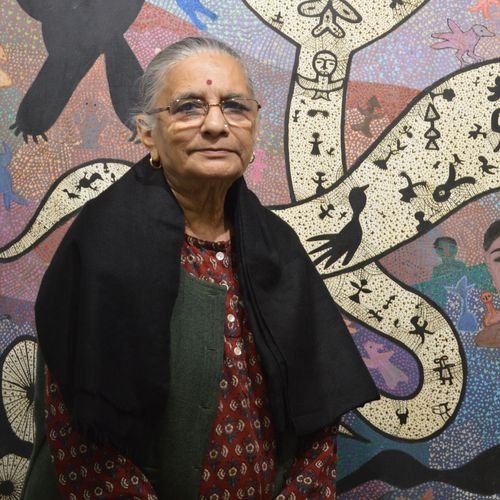
Iconic artist Madhvi Parekh’s paintings are influenced by her childhood memories, present environment and global consciousness. Her works unfold organically, evolving like stories that adapt to the scale they demand, growing from a single point into expansive narratives. Raised in the village of Sanjaya, Gujarat, Parekh was immersed in folk traditions, such as rangoli designs, rituals, and local legends, which shaped her early artistic sensibility. Self-taught, she began painting in 1964, encouraged by her husband, artist Manu Parekh, who gifted her a book on Paul Klee’s drawing exercises. This sparked her artistic career, blending folk motifs, mythical figures and imaginary characters in both figurative and abstract forms. Her works feature rhythmic repetition of geometric shapes—dots, lines, circles, and triangles—drawing comparisons to Paul Klee’s style, while fantastical creatures signal Joan Miró’s influence. Traditional Indian art forms, like Kalamkari and Pichwai, also inform her compositions, with main figures centrally positioned and secondary elements occupying the borders. Parekh captures folklore, personal history, and universal themes of life and imagination. A documentary on the Parekh couple, Dwity, was made in 1992, and a retrospective of her work has been shown in New Delhi, Mumbai, and New York.
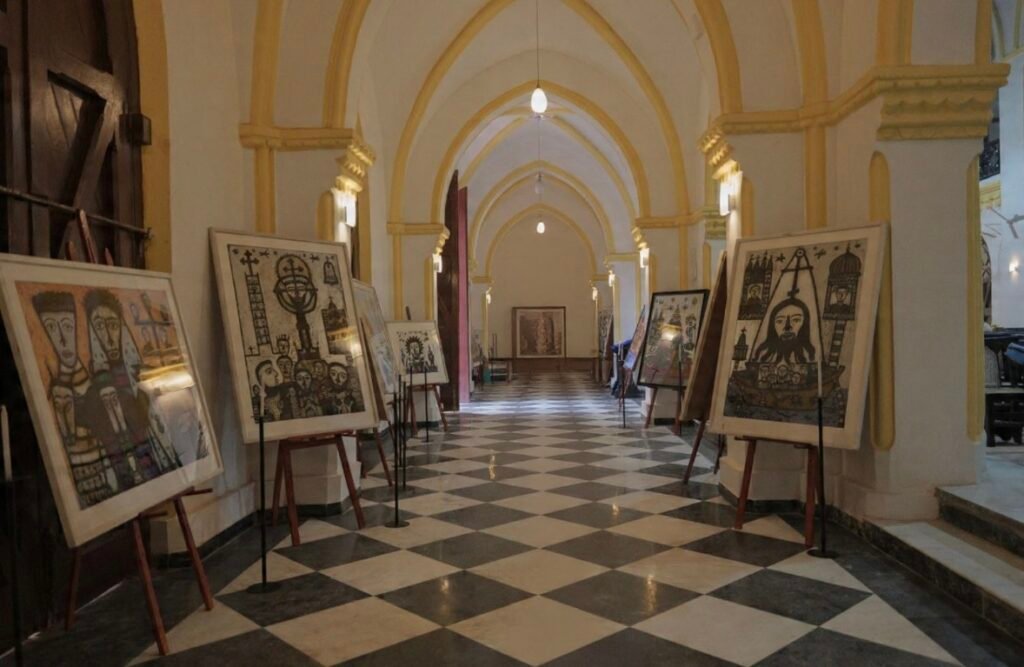
Madhvi Parekh’s art navigates the universal and the intimate, inviting viewers to reflect on faith not as doctrine but as shared humanity. Born in Gujarat, Parekh’s early life was steeped in the tactile rituals of rural India – floor patterns, embroidery, and mythological tales told by her mother. These influences gave her art a rhythmic quality, where the sacred is intertwined with the everyday. Parekh’s fascination with Jesus transcends religion; for her, he is a muse—a figure of suffering and compassion whose story speaks across cultures. At St. James’ Church, Parekh’s works engage light to transform them into living presences. Sunlight streams through stained glass, and candles flicker against her luminous surfaces, turning the viewing experience into a quiet ritual. The church becomes an extension of her canvas, its shifting light echoing the spiritual ambiguity of her themes. At their core, her paintings remind us that faith and art are not fixed – they are processes, constantly reinterpreted, constantly alive.